
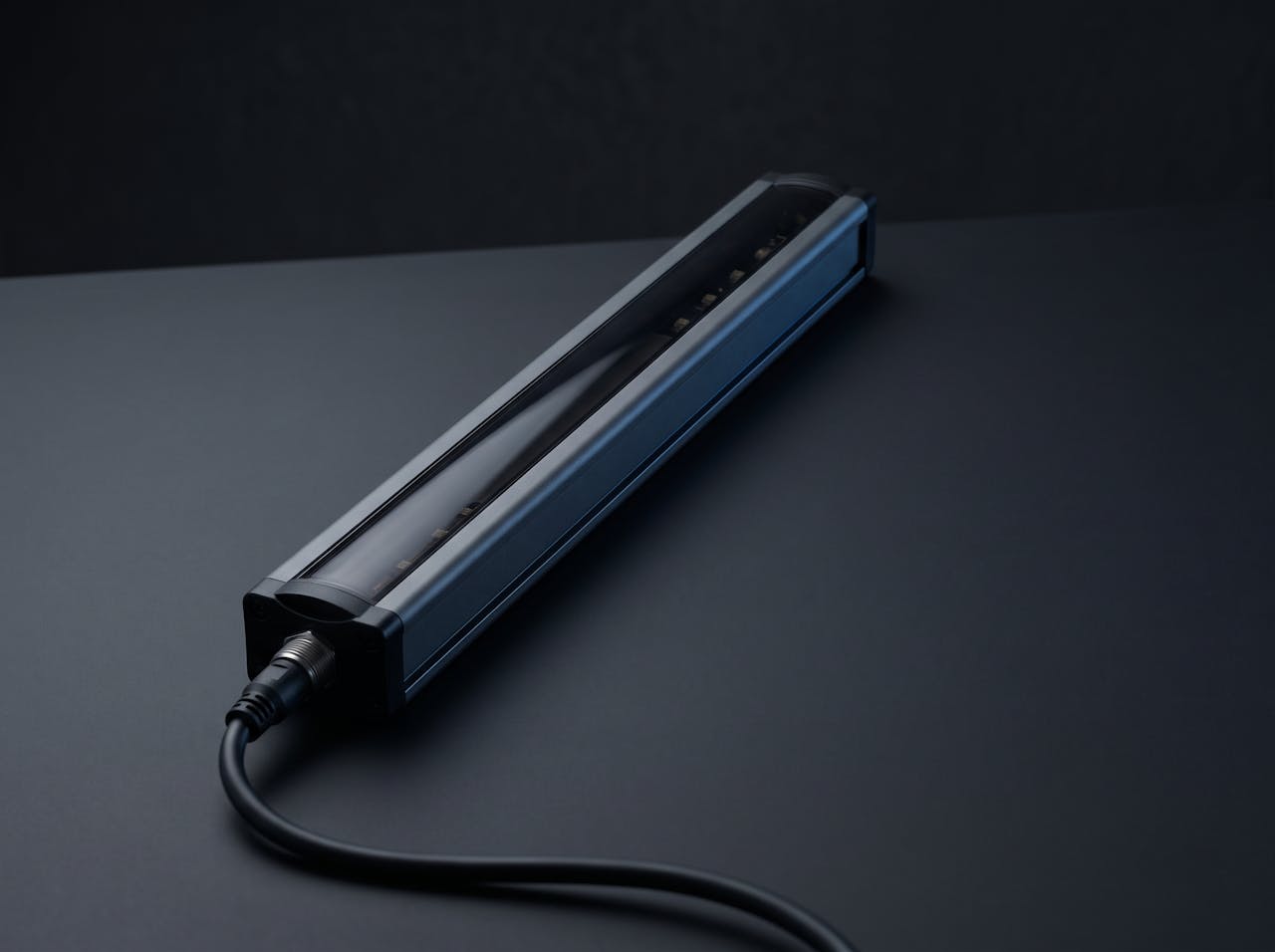
Repairing a safety device is technically ordinary and contractually delicate. The engineering is well understood; what causes problems is the gap between what a repair report actually says and what the person reading it assumes it says.
This article is about that gap, because getting it wrong is a legal exposure rather than a quality one.
What can be repaired
Safety light curtains and light guard systems take physical abuse by design — they are mounted precisely where forklifts, pallets and people pass. Common faults are correspondingly physical:
- Failed safety outputs and OSSD faults
- Dead emitter or receiver segments
- Alignment faults following impact
- Failure of the start-up self-test
- Intermittent operation as the machine warms up
- Nuisance tripping with nothing in the guarded area
All of these are repairable at component level. None of them is exotic.
What verification actually involves
OSSD stands for Output Signal Switching Device — the component of an electro-sensitive protective equipment device connected to the machine control system which, when the sensing function is actuated during normal operation, responds by going to the off state. The term is defined in IEC 61496-1 and reproduced in HSE's guidance on safety in the use of machinery, HSG180.
OSSDs are provided as a redundant pair so that a single fault cannot silently defeat the protective function. Correct verification therefore has to exercise both channels independently — checking that the device switches off is not the same as checking that both of its safety outputs do.
Proper testing of a repaired light curtain covers:
- Both OSSD outputs monitored independently, with inputs activated, confirming correct switching behaviour
- Infrared emitters tested to manufacturer specification for alignment and output strength
- Beam-by-beam verification across the full protected height, not a spot check
- Response time confirmed against specification
- Complete test documentation returned with the unit
That last point matters more than it sounds. Test evidence is what an auditor will ask to see, and evidence assembled at the time is worth considerably more than evidence reconstructed afterwards.
The boundary
Here is the distinction that the whole article rests on.
A repairer can confirm that the device performs to the manufacturer's specification. That is a statement about a component on a bench.
The safety function is the whole protective arrangement as installed: the device, its mounting and alignment, its distance from the hazard, its wiring, the logic it feeds, the actuator that finally removes power, and the stopping performance of the machine. No bench test can speak to any of that.
A repair certificate is therefore necessary but not sufficient. It does not revalidate your safety function, and it does not discharge your duty.
This is not a disclaimer bolted on for caution. It is a real limitation of what bench testing can establish, and a repairer who implies otherwise is doing their customer a disservice.
The OEM restriction, and why it matters
The notice at the top of this page is the single most commercially inconvenient thing on our website, so it is worth explaining why it is there rather than buried in a terms page.
Where a manufacturer prohibits third-party repair of its protective devices, this is a genuine constraint rather than a formality. A device repaired outside that route may fall outside the manufacturer's declaration of conformity — which means that if the protective function is ever questioned, you are relying on your own validation rather than on theirs. For equipment whose entire purpose is to stop a machine before it injures somebody, that is a materially different position to be in, and it is one you should enter knowingly or not at all.
If an OEM does restrict repair on your device, the defensible options are OEM repair, replacement, or a documented engineering decision taken by a competent person with your safety file updated to match. What is not defensible is finding out afterwards.
Where the duty actually sits
In Great Britain, the Provision and Use of Work Equipment Regulations 1998 (PUWER) place duties on the employer — the person who provides and controls the equipment — to ensure that work equipment is suitable for its purpose, maintained in efficient working order and in good repair, and inspected where safety depends on the installation conditions.
Those duties do not transfer to a repairer because a repair was carried out competently. Sending a light curtain away and getting it back with a test report is part of maintaining the equipment properly; it is not a substitute for the duty holder satisfying themselves that the protective function works on the machine.
Treat a repaired safety component exactly as you would treat a new one. If you would revalidate the safety function after fitting a new light curtain, revalidate it after fitting a repaired one.
If your organisation has a written procedure for the former and nothing for the latter, that gap is worth closing before an inspector finds it.
When the answer should be no
There is one more thing a customer is entitled to expect on safety-related work, and it runs against commercial interest.
If a fault on a safety device cannot be resolved with full confidence in the protective function, the unit should not come back marked as repaired. On general equipment there is room for a pragmatic judgement about residual risk. On a device whose entire purpose is to stop a machine before it injures somebody, there is not.
Our repair partners work to that standard: safety devices are either verified against manufacturer specification with the evidence to show it, or they are not returned as repaired. Details of the process are on the light curtain and safety guard repair page.
A short checklist
- Tell the repairer, at enquiry stage, that the device is safety-related — it changes the evidence that comes back with it.
- Ask specifically for OSSD verification and emitter performance against manufacturer specification.
- Keep the test documentation with your machine file, not with the purchase records.
- Revalidate the safety function on the machine after refitting, as you would with a new device.
- Record that revalidation. The repair report and your validation record are two different documents and an auditor will want both.
None of this is onerous. It is mostly a matter of not assuming that a clean test report has done a job it was never able to do.