
Cube storage is unforgiving in a specific way. On a conveyor system a failure degrades throughput; you route around it, you work the backlog, you keep picking. On a grid, the robots are the system. Lose enough of them and there is no manual fallback, because there are no aisles to walk down and no shelves to pick from by hand.
That changes the maintenance economics completely, and it is why the question people ask about grid spares is almost never "what does this cost?" It is "how fast can I have it?"
What is actually inside a grid robot
Strip the branding away and a cube storage robot is a small, hard-working mobile machine with four jobs: travel in two axes across the top of the grid, lift and lower a bin, manage its own power, and stay in contact with the control system. Each of those maps to a set of components, and each set fails in a recognisable way.
| Subsystem | What it does | How it tends to fail |
|---|---|---|
| Drive / wheel motors | Moves the robot in X and Y across the grid top | Bearing wear, rising current draw, loss of smooth motion, eventual stall |
| Lift mechanism | Raises and lowers the bin from the stack | Wear in the lift drive and its transmission, positional inaccuracy, failure to complete a cycle |
| Control and driver PCBs | Commands the motors, runs the logic, handles I/O | Component-level failure on driver stages, thermal fatigue on solder joints, communication faults |
| Battery and charge path | Stores energy, takes charge at the charging position | Cells reaching end of life, capacity fade, charge contacts not seating or wearing |
| Communications | Keeps the robot in contact with the controller | Intermittent dropouts, often environmental or connector-related rather than a dead board |
None of that is unusual. It is motor work, multilayer PCB rework, and battery and power electronics — the same disciplines that keep drives, conveyor motors and control boards running everywhere else on an automated site.
AutoStore does not publish component-level service documentation, and we are not an AutoStore partner. Where the internal arrangement is described below, it is drawn from AutoStore's own published product pages, its patent filings, and what independent repair houses state publicly about units they have worked on.
Patent filings describe intended designs and are not a guarantee of what is inside any particular robot on your grid. We have flagged where a statement is an inference rather than a published fact.
The drive motor, specifically
The single most useful thing to know about grid robot repair is what the drive motor actually is, because it determines the entire wear picture — and it is not what most people assume.
The AutoStore robot servo motor carrying part number AS-35085 is publicly identified by UK motor repair specialists as an Engel GNM8070/4 permanent-magnet DC servo motor — a brushed machine. Published refurbishment scopes for it cover R5, R5+ and B1 robots, and the same part is sometimes numbered AS-35031.
That matters because a brushed motor has a completely different consumables list from a brushless one:
- Carbon brushes — a genuine wear item, consumed in normal service
- Commutator — wears with the brushes, and can be machined back true rather than scrapped
- Bearings — the usual mechanical wear item, with housings often reclaimable
- Encoder — the feedback device, replaceable independently of the motor itself
- Permanent-magnet field strength — measurable, and a real indicator of remaining life
Every item on that list is a routine electromechanical repair. A published refurbishment sequence for these motors runs: strip and clean, measure and reclaim the bearing housings, machine the commutator, balance the armature, fit new carbon brushes, measure the magnet field strength, fit new bearings, fit a new encoder, rebuild and test.
As it arrived
What follows are photographs of one AutoStore robot drive motor through a refurbishment. The condition in the "before" frames is not a failure — it is normal wear on a brushed machine that has been doing its job, and all of it is recoverable.
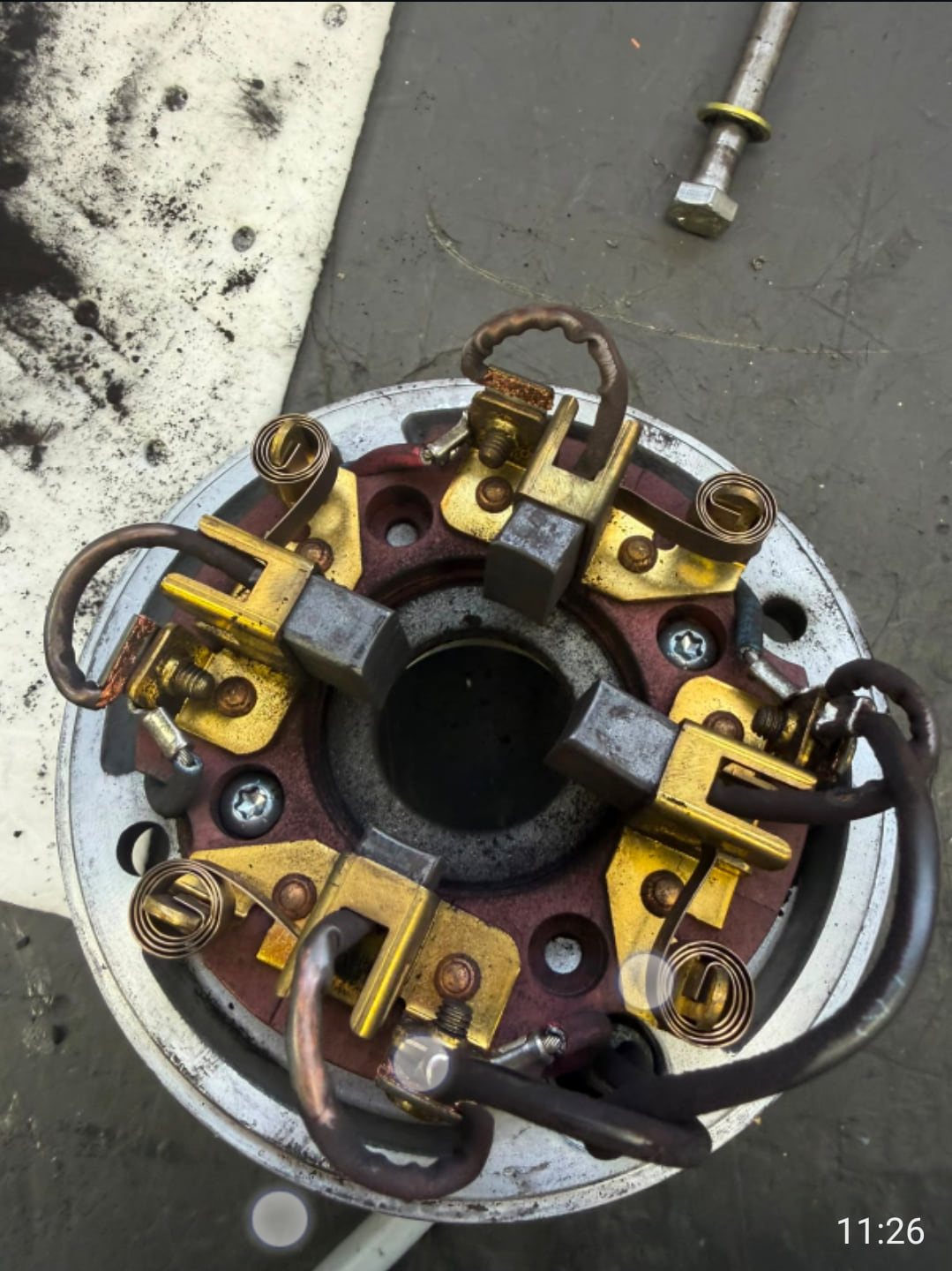
Carbon everywhere. Brush wear deposits conductive dust right through the machine. Left long enough it tracks across the commutator, and that is the point at which these motors start presenting with the earth faults repairers report seeing.
The armature
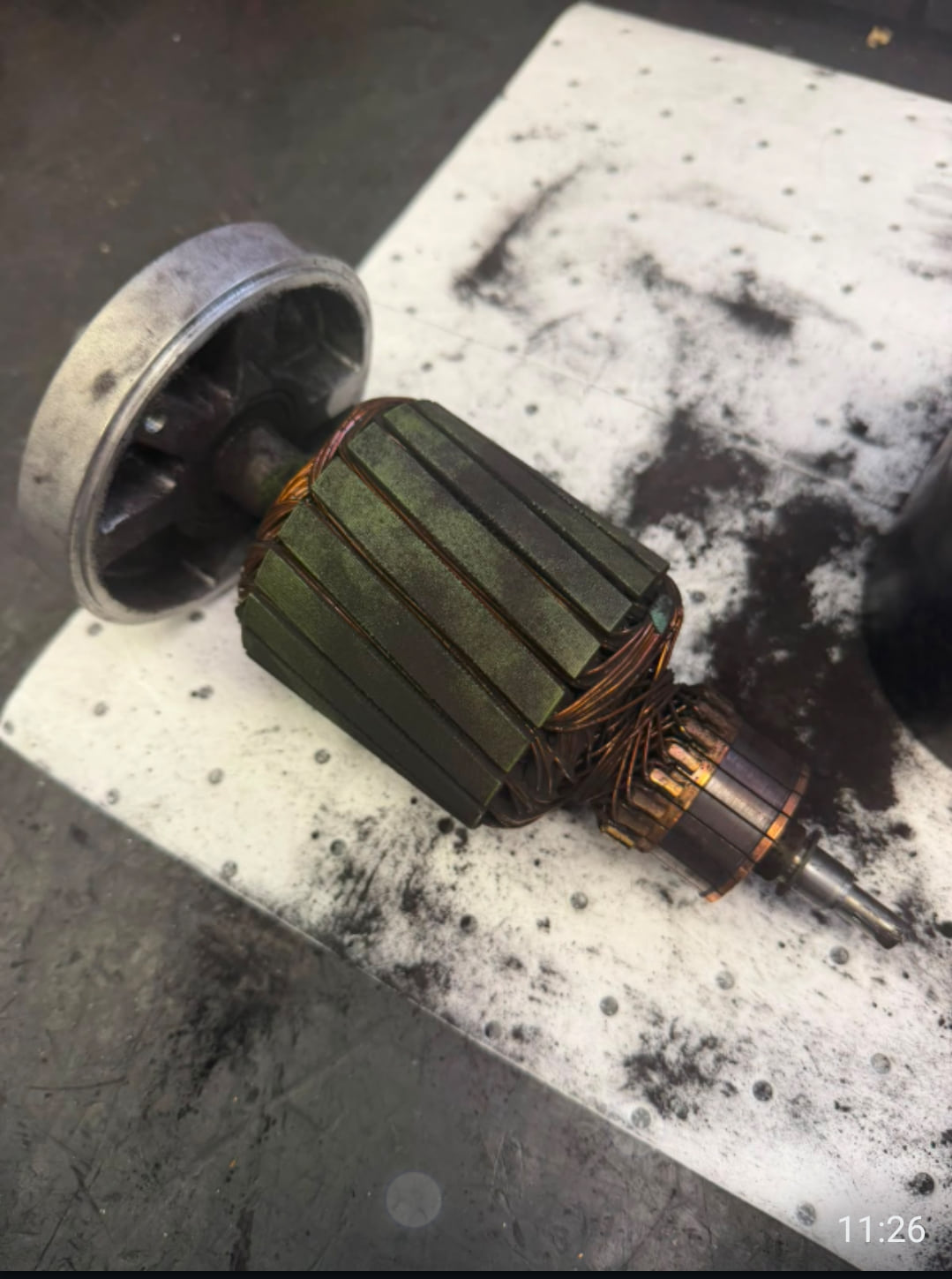
As it came out. The commutator is blackened and the segments have lost their copper face. Carbon dust from brush wear is through the whole machine — left long enough it tracks across the commutator and starts causing the earth faults these motors are known to present with.
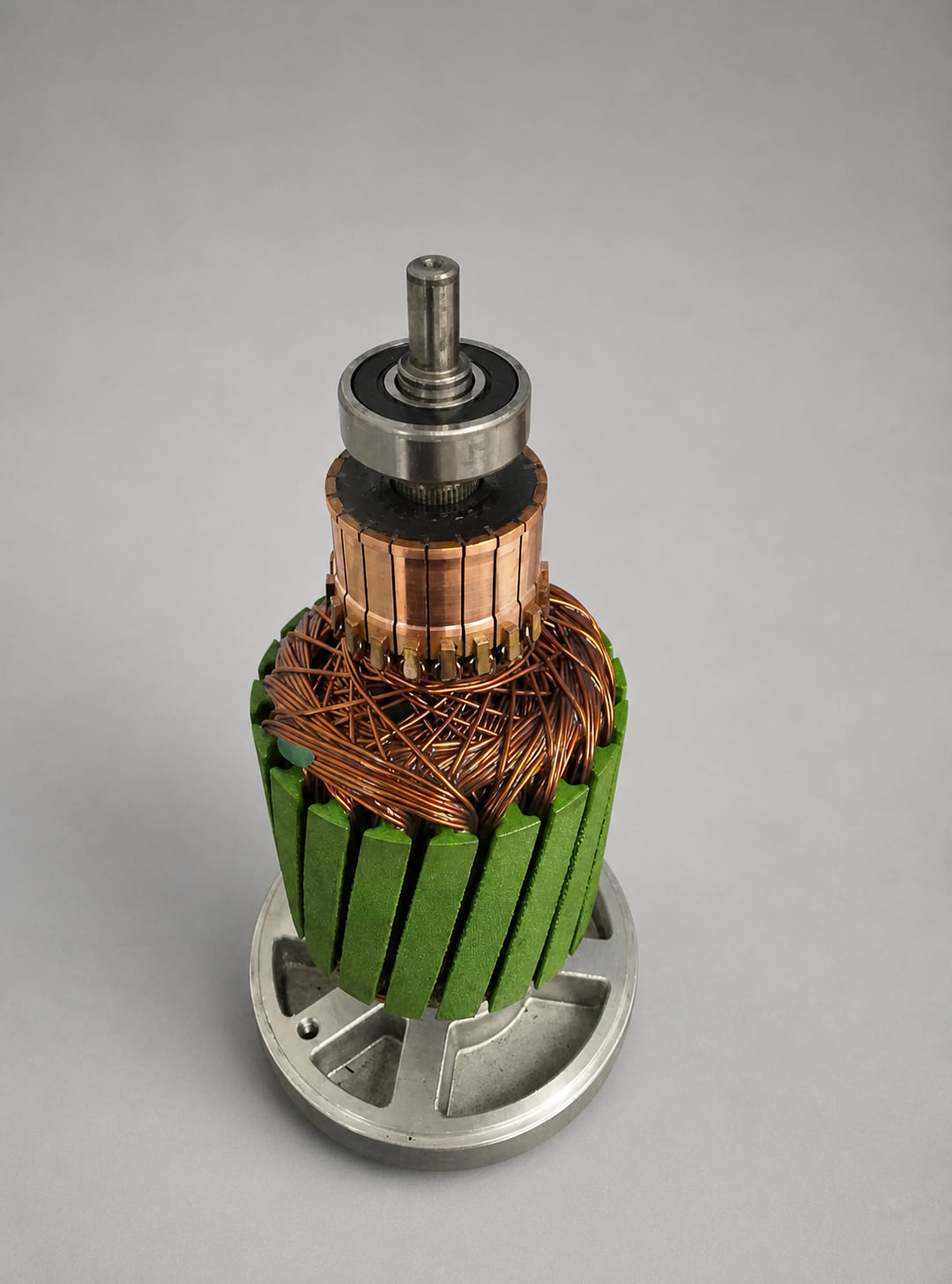
The same armature, rebuilt. New bearing, cleaned windings, machined commutator. Balanced before it goes back in.
The commutator
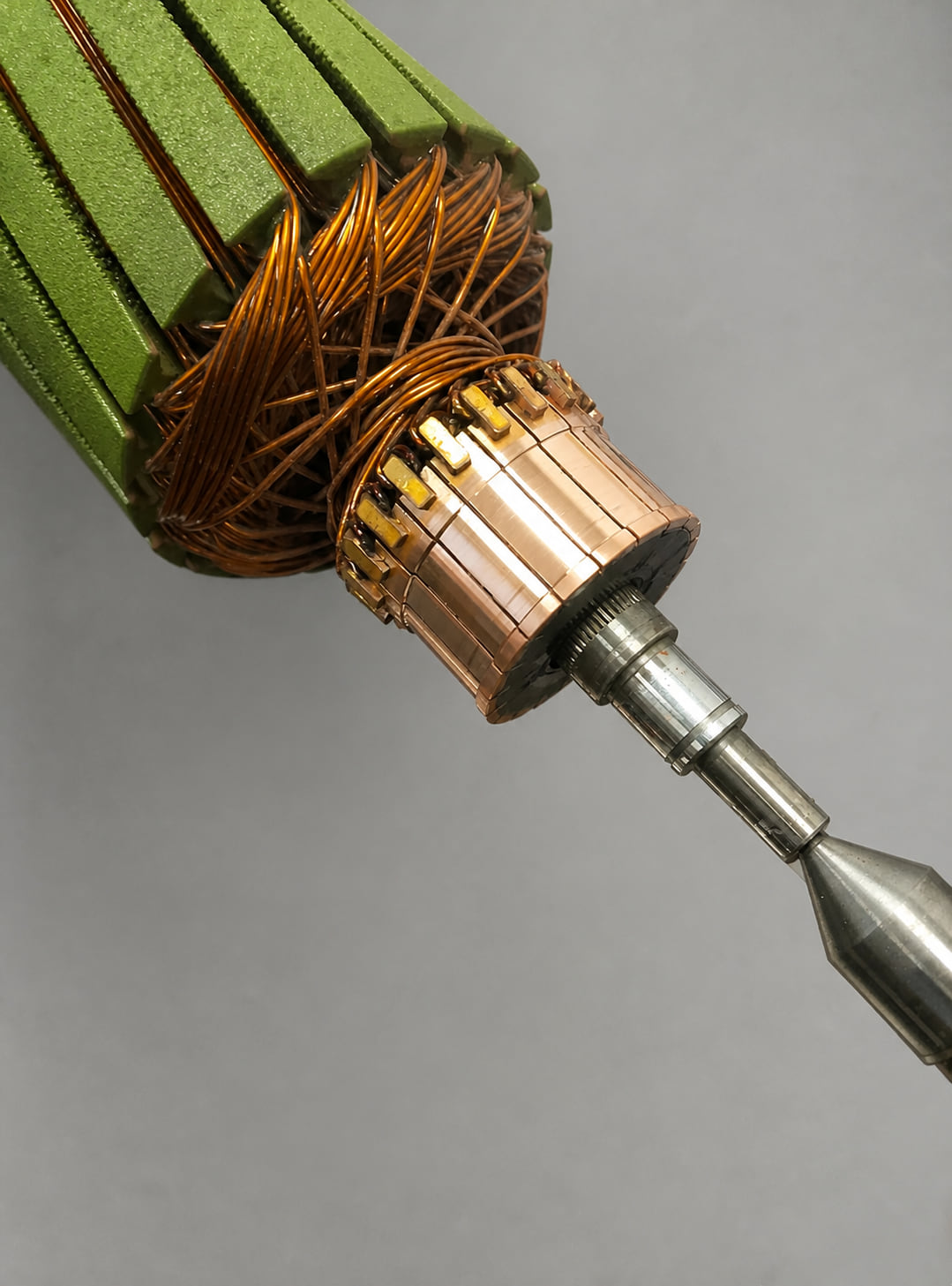
The commutator is the part most people assume is scrap. It is not — it is machined back to a clean, concentric copper face on a lathe, and the segments re-undercut so the insulation sits below the copper rather than lifting the brushes.
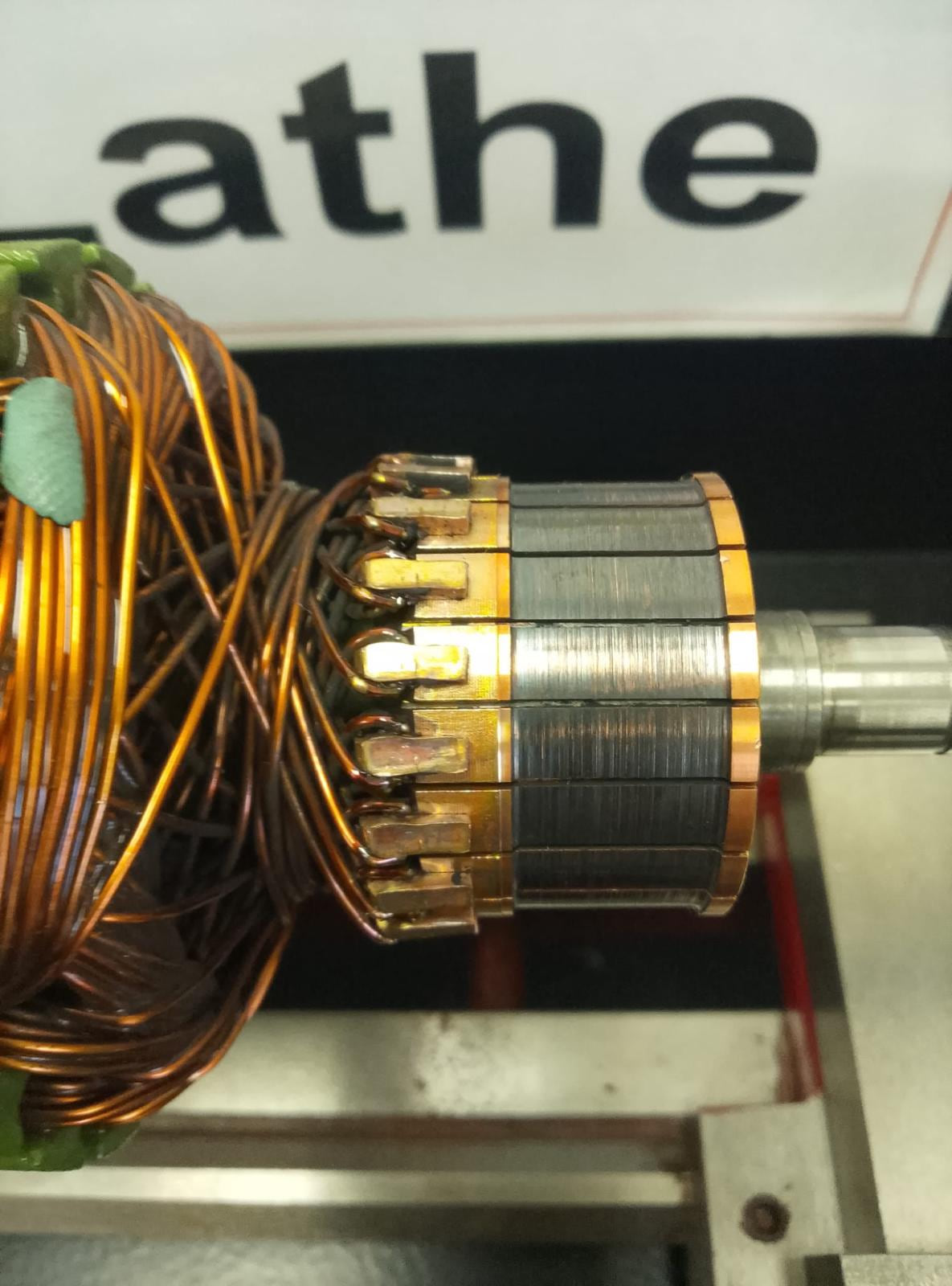
On the lathe. Turned between centres, so the commutator runs true to the shaft rather than merely round.
Finished face. Bright copper, even segments, insulation undercut. This is what the new brushes bed onto.
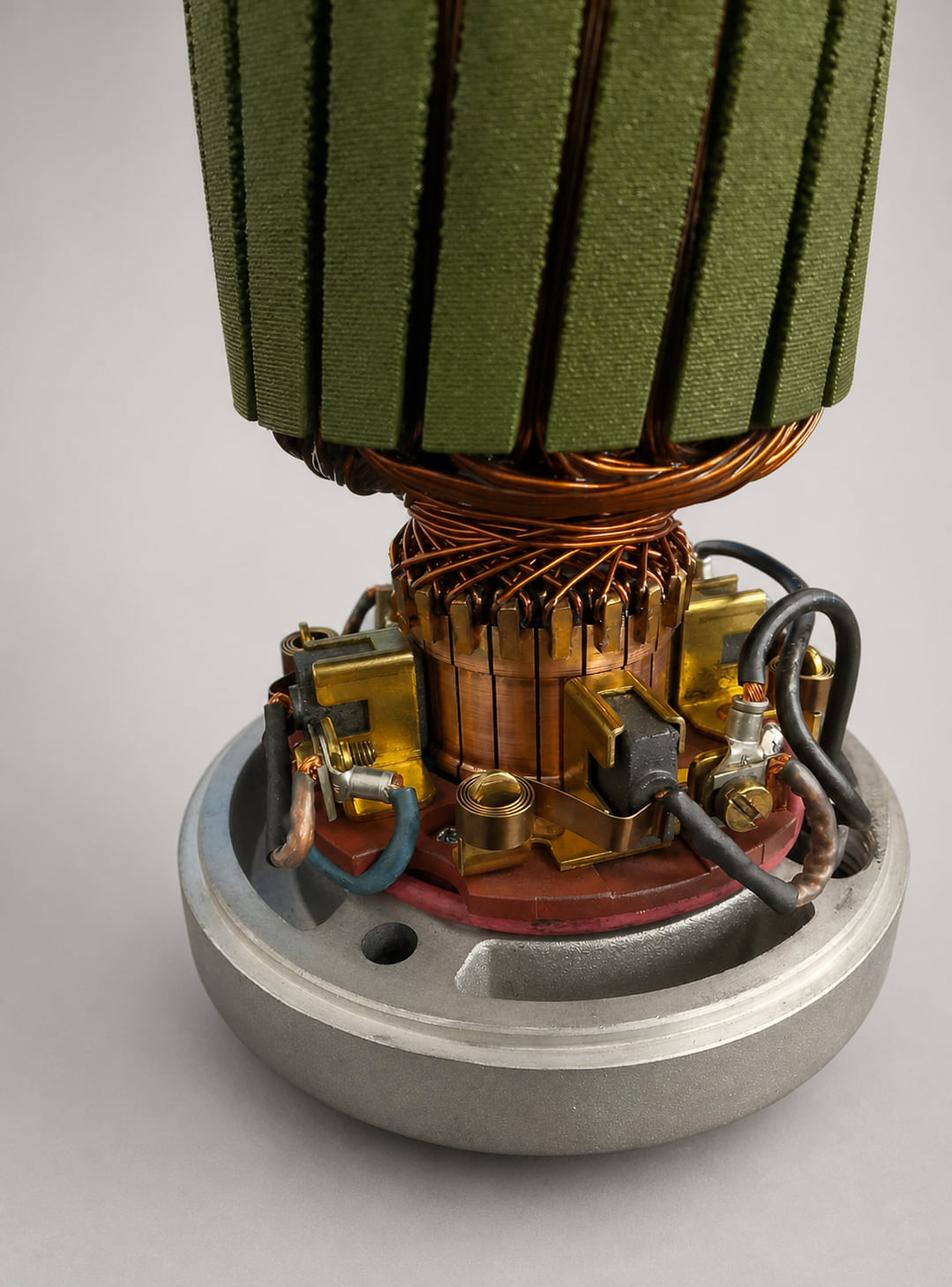
Reassembled. New brushes bedding onto a machined commutator, on a motor that had been a candidate for replacement. Total consumable bill: a set of brushes and a pair of bearings — ordinary stock items, not a proprietary spare on a long lead time.
Total consumables on that job: brushes, bearings, and a skim of the commutator. Compare that with the cost and the lead time of a replacement motor and the argument makes itself.
The same Engel GNM motor family is listed for repair, refurbishment and service exchange by general industrial repair houses whose listings make no reference to AutoStore at all. The motor is an ordinary industrial servo motor that happens to be fitted to a grid robot.
In other words, this is not a specialist capability that has to be invented. It is work the industrial repair market already does.
On reported symptoms, UK repairers working on these motors describe them as typically presenting with an earth fault or an encoder error. Read that as what arrives at a repair bench, not as a fleet failure distribution — units sent for refurbishment are a self-selecting sample, and no published survey of grid-wide failure rates exists. It is a useful pointer for triage, not a statistic.
On availability, the same sources report customers finding these motors either not readily available or on a long lead time. That is the commercial driver behind this entire article.
Batteries and duty cycle: the numbers AutoStore publishes
Battery life is the one area where AutoStore gives genuinely useful published figures, and they are duty-dependent rather than a single number. For the R5's lead-acid battery, AutoStore's own documentation indicates approximately:
| Duty | Approximate battery life |
|---|---|
| 8 hours/day, 5 days/week | around 8 years |
| 16 hours/day, 5 days/week | around 4 years |
| More than 16 hours/day, or more than 5 days/week | around 2 to 4 years |
The R5 carries two 12 V, 105 Ah AGM lead-acid batteries. The newer R5 Pro range moved to lithium-titanium-oxide chemistry, and the B1 uses exchangeable lithium-ion packs swapped at grid stations rather than docking to charge — so do not apply the figures above to anything but the lead-acid R5.
For context on how hard these machines work: AutoStore describes a typical working day for R5 and R5+ as about 20 hours, with each robot needing at least four hours of charging per day, and around 30 bin presentations per robot per hour. A grid running near those numbers is running its consumables near the bottom row of that table.
If your grid runs two shifts or more, budget for battery replacement in the four-year region rather than the eight-year one, and treat brush and bearing wear on the same accelerated basis. Duty is the variable that matters, and it is the one most likely to have changed since the system was specified.
The failures that actually strand a robot
The useful distinction is not electronic versus mechanical. It is gradual versus sudden, because that determines whether you get a warning.
Gradual, and therefore catchable
- Rising current draw on a drive axis. A motor that is beginning to fail works harder for the same duty. This is measurable long before it stalls, and it is the single most useful early indicator on a grid.
- Erratic or rough motion. Bearing degradation shows up as motion quality before it shows up as a fault code.
- Battery capacity fade. Runtime between charges shortens gradually. If you are tracking it, you can schedule the swap; if you are not, you find out when a robot runs flat somewhere inconvenient.
- Charge contact wear. Contacts that no longer seat reliably cause intermittent charging, which looks like a battery fault and often is not.
Sudden, and therefore expensive
- Driver stage failure on a control PCB. Usually takes an axis out immediately.
- Connector or harness damage. Frequently intermittent first, then permanent, and often misdiagnosed as a board fault.
- Lift mechanism failure mid-cycle. The worst case, because the robot may be holding a bin when it happens.
If you are only reacting to faults, you are only ever seeing the sudden category, and paying the full downtime cost of the gradual one. Current draw and cycle-completion data are already being produced by the system — the question is whether anyone is looking at the trend.
Repair or replace, on a grid specifically
The general repair-versus-replace framework applies here as it does anywhere, and we have written it up separately in repair or replace: a decision framework. But grids have one factor that dominates all the others.
Lead time is usually the deciding number, not unit price. A grid running short of serviceable robots is losing throughput every day. If a repair route returns a working assembly in a week and the alternative is a longer wait for a new part, the repair wins even when the two prices are close — and they usually are not close.
The second factor is the shelf. Most sites running automated equipment for a few years have accumulated failed assemblies that were pulled, replaced and never disposed of, because nobody was quite willing to skip them. On a grid that shelf is frequently the cheapest spares holding available, and assessing it costs nothing but the collection.
AutoStore states that its system "is distributed, designed, installed, and serviced by a network of qualified system integrators". In practice that means your service and support relationship is normally with your integrator, not with AutoStore directly — and your contract is with them too.
Before committing to any third-party repair route, check what your integrator agreement says about who may work on the equipment and what effect that has on support or warranty cover. That is a commercial question rather than a technical one, but it is very much better answered before a unit is sent than after.
What good testing looks like
A grid robot assembly that powers up on a bench has proved almost nothing. The failures that matter are load-dependent and thermal, so the testing has to be too.
- Coil resistance and winding health on every motor, not just the one that was reported.
- Live current-draw monitoring under load, which is what catches a marginal motor before it strands a robot in service.
- Charge and discharge cycling on battery and contact assemblies, measuring actual delivered capacity rather than terminal voltage.
- Communications and I/O verification against a controller, not just continuity.
- Soak testing before release, because thermal faults do not appear in the first five minutes.
Our repair partners work to that standard on grid components, with board-level rework carried out by IPC-7711/7721 certified technicians under an ISO 9001 quality management system. Test evidence comes back with the unit.
Where to start
If you run a grid and have never had failed assemblies assessed, start with the shelf rather than with a live problem. It is lower risk, it tells you what your actual recovery rate looks like, and it gives you a spares pool before you need one.
If you are already short of serviceable robots, say so at the point of enquiry — batches get triaged on arrival rather than queued.