
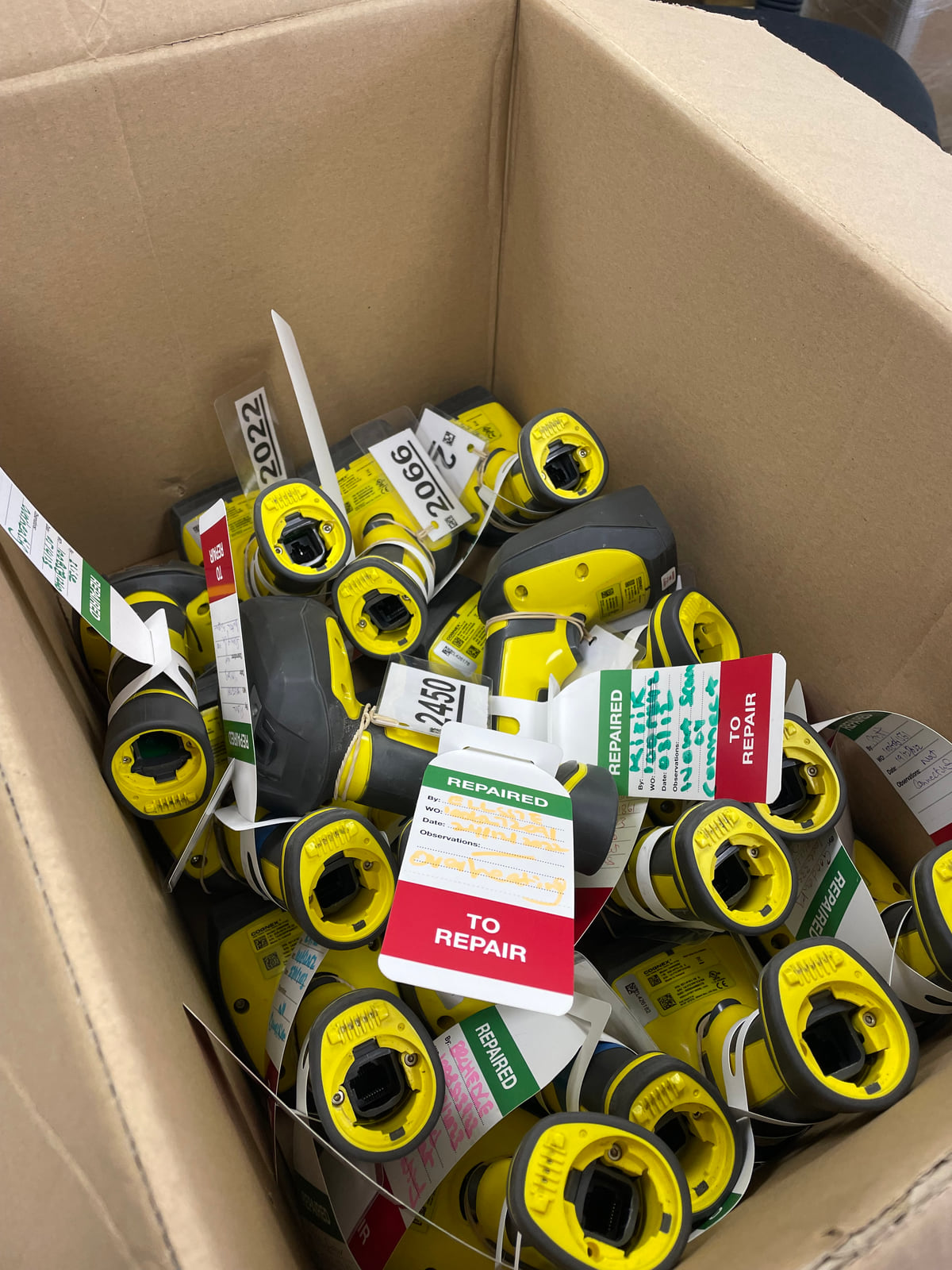
Ask for a replacement price and you will have it in an afternoon. Ask what replacing it will actually cost you and the answer takes longer, involves more people, and is usually a good deal larger. That asymmetry is why repair-versus-replace decisions so often default to replacement: one number is easy to get and the other is not.
This is a framework for getting the second number, and four questions that settle most cases without needing it.
The costs that appear on the quote
Straightforward, and the only part most comparisons include:
- Purchase price of the replacement unit, or the price of the repair
- Carriage
The costs that do not
This is where the decision usually turns.
| Cost | Applies to | Frequently forgotten because |
|---|---|---|
| Downtime while waiting | Replacement, when lead times are long | It lands on production's budget, not engineering's |
| Re-parameterising and configuration | Replacement | The engineer who did it last time knew the settings by heart |
| Re-commissioning and proving | Replacement | It is assumed to be quick until the successor model behaves differently |
| Operator and engineer retraining | Replacement, where the interface changes | It is absorbed as "getting used to it" rather than costed |
| Revalidation | Replacement or repair of safety-related items | It is a legal duty rather than a line item |
| Knock-on integration work | Replacement of obsolete items | The successor needs a different card, cable or firmware |
| Disposal and WEEE handling | Replacement | Someone else deals with it |
| Loss of failure history | Replacement | Nobody notices until the same fault recurs and there is no record |
Repair carries almost none of these. That is the structural reason repair tends to win on anything embedded, configured or obsolete — not the headline price.
The four questions
1. Can you actually buy it, and when?
If the answer is "yes, from stock, tomorrow", replacement is a genuine contender. If it is "yes, in ten weeks" or "no, it is superseded", the decision is very likely already made. Multiply your downtime cost per day by the difference in availability before looking at either price — for a lot of sites that single calculation ends the discussion.
2. How much configuration is in the unit?
A power supply holds no configuration. An HMI holds screens developed over years, a drive holds a parameter set someone tuned on a night shift, a controller holds the program. The more of that a unit carries, the more replacement costs beyond its price — and the more it argues for repair.
3. What else would have to change?
Obsolete equipment rarely has a drop-in successor. Ask what the replacement needs that the original did not: a different fieldbus card, different firmware, a different cable, a different footprint in the panel. Integration work is where replacement budgets go wrong.
4. Is it safety-related?
If the item forms part of a safety function, both routes carry a revalidation duty and neither is a straight swap. That does not settle repair versus replace, but it does mean the cheaper-looking option is not automatically cheaper. We have written about that boundary separately in what a repairer can and cannot certify.
When replacement genuinely is the right answer
Repair is not always the better buy, and a repairer who never says so is not being useful. Replace when:
- The unit is physically destroyed — fire, crush damage, severe water ingress into a sealed assembly
- The item is cheap, current-production and stocked, with no configuration in it
- The failure is so widespread across the board that the repair cost approaches replacement
- The equipment is already scheduled for replacement as part of a planned upgrade
- The failure rate indicates the unit is fundamentally unsuited to the duty, in which case neither route fixes the actual problem
What "beyond economical repair" actually means
It sounds like a property of the unit. In practice it is a statement about the person doing the assessing, and it varies far more than most people expect.
Two repairers can reach opposite verdicts on identical items, for entirely legitimate reasons: how deep their diagnostics go, whether they have a test method for that board, whether they can source the failed component, and whether they have seen the fault before. A repairer with no test rig for a given assembly cannot validate a repair on it, so declining is the honest answer — but it is an answer about their capability, not about the assembly.
This is why batches of equipment condemned by one provider are frequently recoverable by another. It is not a claim that previous assessments were careless; it is that "we cannot economically fix this" and "this cannot be fixed" are different statements that get written down the same way.
Two of the case studies on this site are exactly that situation — a fleet of scanners and a set of operator panels that had already been written off.
Why nobody can give you a percentage
You will find figures quoted online for what repair "typically" costs as a proportion of replacement — commonly something like 15 to 50 per cent. Treat them with caution. We could not find an independent, generalisable published benchmark for industrial automation electronics; the widely circulated ranges trace back to repair providers' own marketing rather than to independent research.
There is a reason for that beyond nobody having done the work. The ratio depends on the item, the fault, the age, the availability of the replacement and the depth of the diagnosis — variables that swamp any average. A single percentage across all of that would be a number with no information in it.
The honest version is: the ratio is item-specific, and the only reliable figure is a quote against your actual unit after diagnosis. Anyone offering you a confident percentage before looking at the equipment is quoting marketing, not engineering.
The same applies to "no fault found" statistics. Published NFF rates vary enormously between studies and almost none of them come from industrial automation, so quoting a headline percentage would be misleading. The mechanism is real and worth understanding — intermittent faults, environmental faults and misdiagnosed installations all produce units that test good on a bench — but the numbers attached to it do not transfer to your site.
Where regulation is heading
Repairability duties in the UK and EU have so far concentrated on consumer and energy-related products rather than on industrial automation. It is worth being precise about what that does and does not mean, because the picture is often described too simply.
- Industrial automation is already covered by ecodesign law, just not by repairability duties. Regulation (EU) 2019/1781 sets efficiency requirements for electric motors and, since July 2021, loss limits for variable speed drives. What it does not do is impose an obligation to make those products repairable or to supply spare parts.
- Some professional equipment already carries spare-parts duties. The UK's ecodesign regulations covering specified energy-related products include a requirement to make spare parts available to professional repairers for a set period on certain product groups — welding equipment among them. The principle is established; the scope simply has not reached automation yet.
- Obsolescence management has its own standard. BS EN IEC 62402 sets out requirements for managing obsolescence across a product's life, which is a more useful framing for an automation estate than waiting for repairability regulation to arrive.
The practical implication is that a repair-first policy for automation spares is currently a commercial decision rather than a compliance one — but the direction of travel is clear enough that building the capability now is unlikely to be wasted effort.
The sustainability column
Repair keeps existing hardware in service, which avoids both the manufacturing impact of a replacement and the disposal impact of the original. For organisations reporting on scope 3 emissions or circular-economy commitments, a repair-first policy for automation spares is one of the few measures that reduces cost and reported impact at the same time.
It is worth having the reporting line agreed in advance, though. A saving nobody is counting tends not to survive the next budget round.
A reasonable default
For automation and control equipment on an established site, assess before you buy. It costs a collection and a diagnosis, it produces a fixed quote and an honest verdict, and it turns a decision made on the one easily-available number into one made on the whole picture.